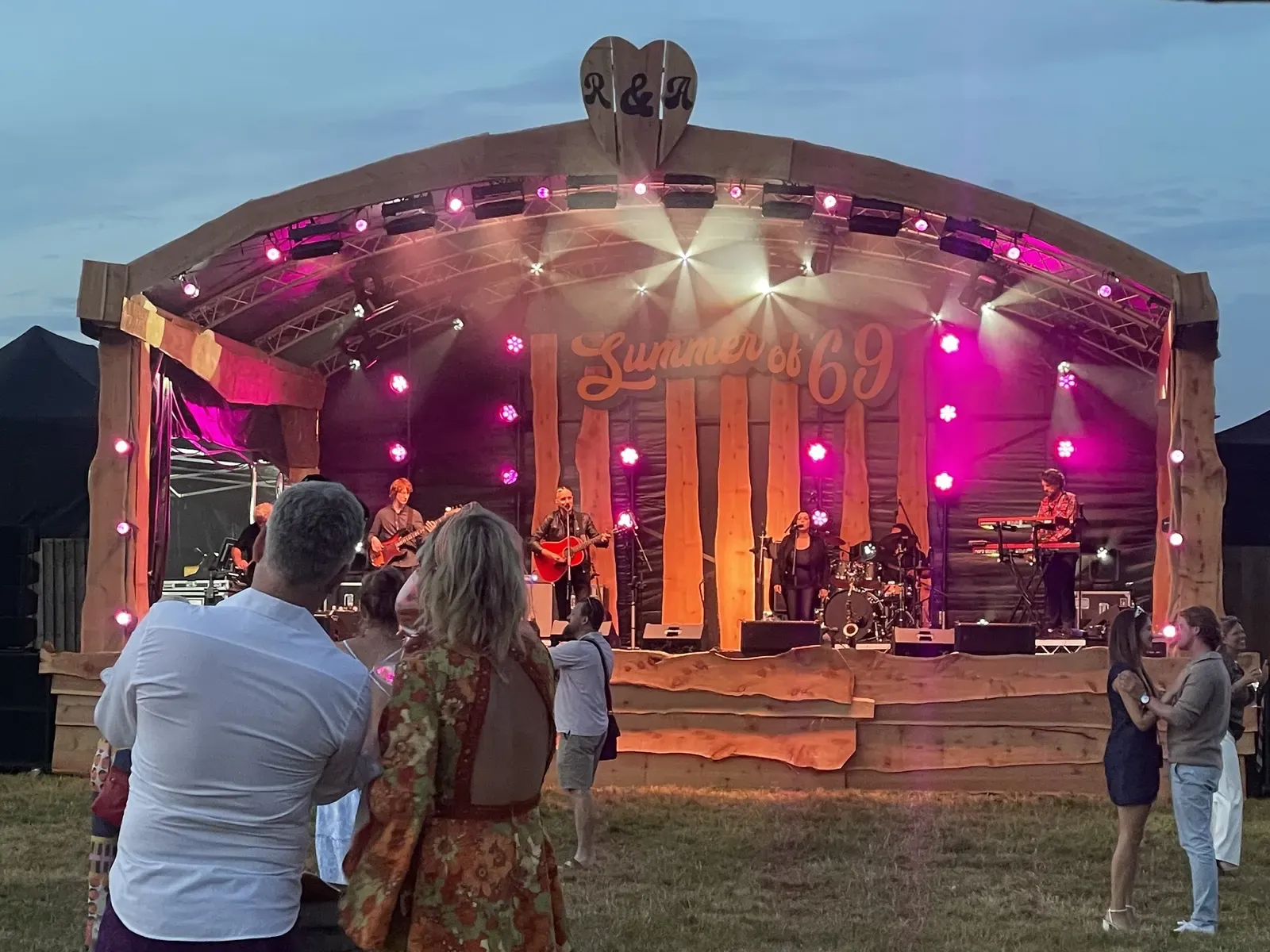
Every marquee party in Surrey is decided by three unglamorous things: whether the power holds, whether the neighbours call the council, and whether the paperwork was needed at all. This guide sets out how we plan each one for parties in Cobham, Esher, Weybridge, the Virginia Water and St George's Hill belt and across the county. It is written for hosts, but it is the same checklist our crew uses.
Power: why the house supply is not enough
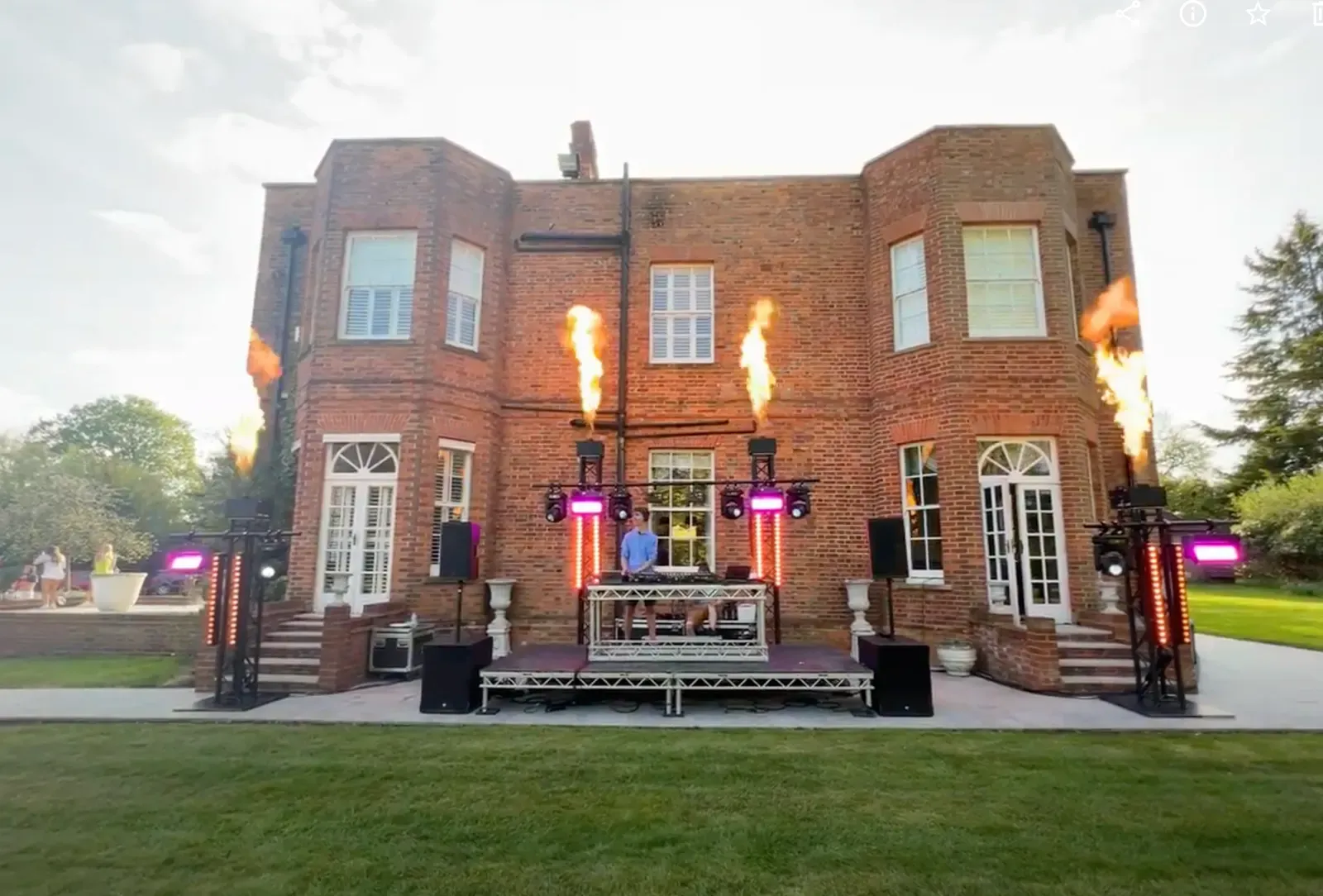
A domestic supply is typically 60 to 100 amps single phase, and most of it is already spoken for by the house. A party adds a dance-floor sound system, a lighting rig, catering ovens and hot cupboards, bar fridges, marquee heating or cooling, and a coffee machine that draws more than the sound system. Running an extension lead from the utility room is how the fridges trip the music at 10 pm. For anything beyond a small sound system and some uplighters, we specify a generator sized for the whole night.
| Load | Typical draw | Notes |
|---|---|---|
| Sound system (d&b or equivalent) with DJ booth | 2 to 4 kW | Peaks higher on bass-heavy music; we allow headroom |
| LED lighting rig, 30 fixtures and 6 moving heads | 2 to 4 kW | Battery uplighters draw nothing from the generator |
| Catering: ovens, hot cupboards, urns | 10 to 25 kW | Ask the caterer for their load sheet; it is usually the biggest number |
| Bar fridges and ice machine | 1 to 3 kW | Continuous, not peak |
| Marquee heaters (electric) or coolers | 3 to 12 kW | Gas heaters avoid this load but need ventilation |
| Toilets, lighting to paths, coffee machine, DJ laptop | 2 to 4 kW | The coffee machine is the one everyone forgets |
| Total, with 25 percent headroom | 25 to 60 kW | A 40 to 80 kVA silent diesel set is the usual answer |
- Generators run best at 50 to 80 percent of rated load. Oversize slightly rather than run one flat out, and never run a diesel set at 10 percent load all night; it will foul.
- Ask for a super-silent set. Modern canopied generators run at about 60 to 65 dB(A) at seven metres, quieter than the party, and we position them downwind and away from the nearest neighbour.
- Armoured cable on every run, cable ramps across any route guests or vehicles cross, and a distribution board with residual current protection by the marquee, not by the generator.
- Fuel for the full duration plus a margin. A 60 kVA set at half load burns roughly eight to ten litres an hour; a 12-hour night needs a full tank and a top-up plan.
- A separate small supply for anything that must not go down, such as the sound system, so that a catering fault does not stop the music.

Noise: the rules and the reality
There is no magic number for a private garden party. Councils act under statutory nuisance law, which means a neighbour's complaint, an officer's judgement and, if it comes to it, an abatement notice. In Surrey the districts that cover our busiest areas, Elmbridge, Runnymede, Guildford and Waverley, all take late-night music complaints seriously and will attend on a Saturday night. The practical reality is that almost every complaint is about bass after 11 pm, and almost every one is preventable.
- Tell the neighbours yourself, in person or with a note, a week or two before: the date, the finish time, and your mobile number. A neighbour who can call you does not call the council.
- Use cardioid subwoofers, which project bass forward and cancel it behind, and point the system away from the nearest houses. This is the single biggest technical difference and it is why we specify d&b V-Subs for garden parties.
- Agree a volume ladder before the night: full until 11 pm, one step down at 11, another at midnight, background only after 1 am. The DJ gets it in writing.
- Keep the marquee walls down on the neighbour side after 11 pm; an open marquee is a loudspeaker.
- Finish when you said you would. A 1 am finish that was announced is tolerated; a 3 am finish that was not is a complaint.
- If the party is large, near several houses, or on a weeknight, we take a sound level meter to the boundary and manage to it. As a guide, keeping music below about 55 dB(A) at the nearest neighbour's boundary after 11 pm avoids most complaints; the widely used concert code allows more for licensed events, but a garden is not a licensed venue.
Licences: when you need one and when you do not
A private party in your own garden, with invited guests, no tickets sold and a free bar, is not normally a licensable event. You do not need a Temporary Event Notice to play music for your guests, and you do not need one to serve them drinks you have paid for. The paperwork starts when money changes hands: selling alcohol, charging for entry, or an event open to the public. Then you need a Temporary Event Notice from the district council, which covers up to 499 people at a time for up to seven days.
| Item | Detail |
|---|---|
| When needed | Sale of alcohol, charging for entry to regulated entertainment, or late-night hot food and drink between 11 pm and 5 am, at a venue without a premises licence |
| Capacity | Up to 499 people including staff and performers |
| Notice period | At least 10 working days before the event for a standard notice; a late notice can be given between 5 and 9 working days but can be blocked by the police or environmental health without appeal |
| Fee | £21 per notice, paid to the district council (check the current fee; it has been the same for years) |
| Limits | A premises can have a limited number of notices per year and a maximum number of event days; most private homes never get near them |
| Who applies | The person organising the event, who must be over 18; a personal licence is not required |
Two things are not licences but still matter: your household insurance may exclude large parties and marquees, so ask, and if you hire staff or a bar company they carry their own liability cover and, for a paid bar, a personal licence holder. We carry public liability cover for everything we build and run.
Ground, weather and the morning after
- Trackway for any vehicle heavier than a car crossing a lawn, especially after rain. A generator truck on wet grass leaves ruts that are still there in spring.
- A hard floor under the dance floor and the bar; a marquee floor on bare grass is a trip hazard by midnight.
- A wet-weather version of the reception plan, agreed at the site visit, that does not need any decision on the day.
- Strike the same night or first thing, with the generator and trackway gone before the neighbours are up.
If you are planning a party in Surrey, the private party production page sets out what we build and run, and the local pages for Cobham, Esher and Weybridge cover the venues and estates we know. Send us the date and the garden and we will come and look at it.