Hybrid & livestream productionLondon & the Home Counties
The in-room show and the remote audience produced as one event: multi-camera video, a separate broadcast audio mix, redundant encoders and a stream producer whose only job is the people who are not in the room.
What a hybrid event needs that a normal event does not
The remote audience is the least forgiving person in the building. In the room, a dropped word or a slide that arrives a beat late passes unnoticed; on a stream it is the whole experience. So a hybrid production is built around three things the in-room show can take for granted: a clean, separate audio mix; cameras and a vision mixer that decide what the remote audience sees, second by second; and connectivity that does not depend on anyone else's network.
| Layer | What we use | Why it matters |
|---|---|---|
| Cameras | Two to four cameras: a locked wide, an operated close-up on the speaker, a PTZ for panels and audience, plus a slide capture | Cutting between angles is what keeps a remote audience watching past minute ten |
| Vision mixing and graphics | A hardware vision mixer with lower-thirds, slide keying and a programme feed to the room screens and to the stream | Names, titles and clean slides on the stream, not a photograph of a projector screen |
| Audio | A dedicated stream mix from the front-of-house console, with mix-minus for remote presenters and lav mics on every speaker | Speech intelligibility is the single biggest predictor of whether people stay; room reverb through an ambient mic is why most streams are abandoned |
| Encoding and connectivity | Two hardware encoders, a dedicated wired line ordered in advance, bonded 4G/5G as automatic failover, a local recording | Redundancy at every point that has failed on someone, somewhere |
| Comms and show calling | Wired and wireless comms between director, camera operators, stream producer and stage manager | The remote audience gets the same cues as the room |
| Remote participation | Q&A moderation, polling, a producer watching chat, a rehearsed way to bring remote questions to the stage | Hybrid only works when the remote audience can affect the room |

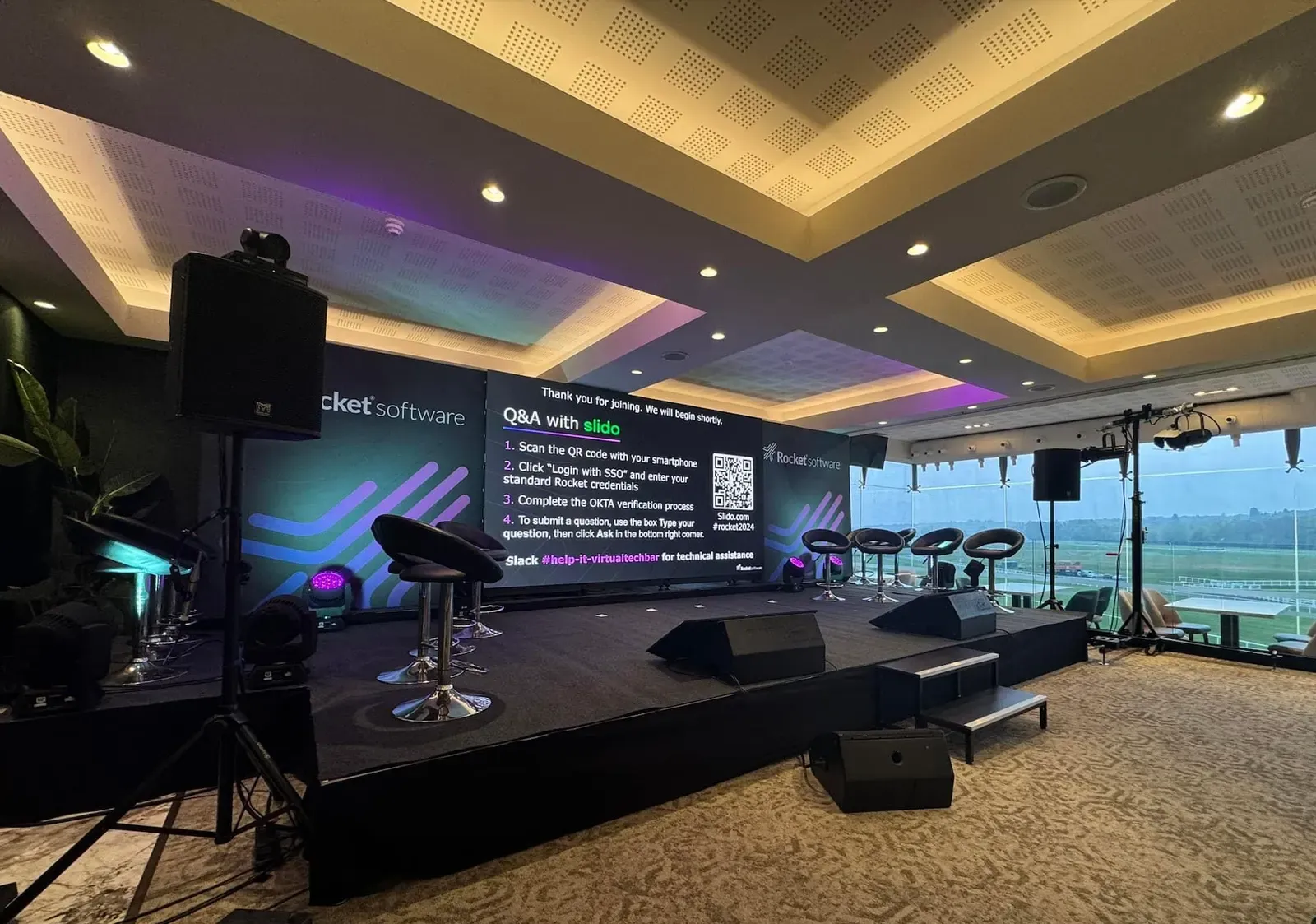
Formats we produce
- Streamed keynote or town hall: one or two cameras, clean slides, broadcast audio, a private link for staff or members.
- Hybrid conference: multi-camera, breakout capture, remote speakers presenting into the room, live Q&A across both audiences.
- Product launch with press online: a directed programme with graphics and a reveal that is timed for the stream as carefully as for the room.
- Awards with a remote audience: nominee reactions on camera, category graphics, a host who talks to the camera as well as the room.
- Studio-style broadcasts from a venue: a small set, three cameras, lit for camera first, with no in-room audience at all.


How we run the day
- Connectivity is ordered and tested the day before. If the venue cannot provide a wired line we tell you early and bring bonded cellular as the primary rather than the backup.
- Every speaker gets a lav microphone and a two-minute camera rehearsal. Remote speakers rehearse the day before with the exact laptop and link they will use.
- A stream producer sits with the vision mixer for the whole event; their job is the remote audience and nothing else.
- We record a clean programme feed locally. You receive the edit-ready recording within 48 hours; a highlights cut can follow if you want one.
- Lighting is designed for camera first: a proper key light on every speaker position and a stage that reads as a set, not a room with a lectern.
If the remote audience is small and internal, a single well-lit camera with excellent audio beats a four-camera shoot with room-mic sound every time. We will say so in the quote.
Where this fits with the rest of the production
Hybrid is scoped alongside the in-room show, never bolted on afterwards, because the two share the audio system, the lighting and the run-of-show. It sits naturally with our corporate event production, our screens and video wall work, and event content capture when you also want the event turned into social and marketing assets. Most of our hybrid work is in London hotels, conference venues and members' clubs, with Berkshire and Surrey country-house offsites the next most common.
Frequently asked
What is the difference between a hybrid event and a livestream?
A livestream sends the in-room event to a remote audience. A hybrid event treats the remote audience as participants: they can see slides cleanly, hear questions, vote and ask their own. Hybrid needs more cameras, a dedicated stream mix and someone whose only job is the remote audience.
Which platforms can you stream to?
Anything that accepts a video feed: Vimeo, YouTube, Microsoft Teams and Zoom webinars, LinkedIn Live, private password-protected players and most corporate event platforms. We advise on the platform from the audience's point of view rather than the other way round.
What happens if the venue internet fails?
We never rely on venue Wi-Fi. A hybrid show runs on a dedicated wired connection with a bonded 4G/5G backup, two encoders, and a recorded local copy, so a failure upstream does not take the stream down and nothing is lost.
How much does hybrid event production cost?
A single-camera streamed keynote with broadcast audio and an operator typically starts around £2,500 on top of the in-room production. A multi-camera hybrid conference with a vision mixer, graphics, a stream producer and remote-audience management usually sits between £8,000 and £25,000. Every quote names the kit and the crew.
Can remote speakers present into the room?
Yes. We bring remote presenters into the vision mix and the room PA with a mix-minus so they hear the room without echo, and we rehearse them the day before.