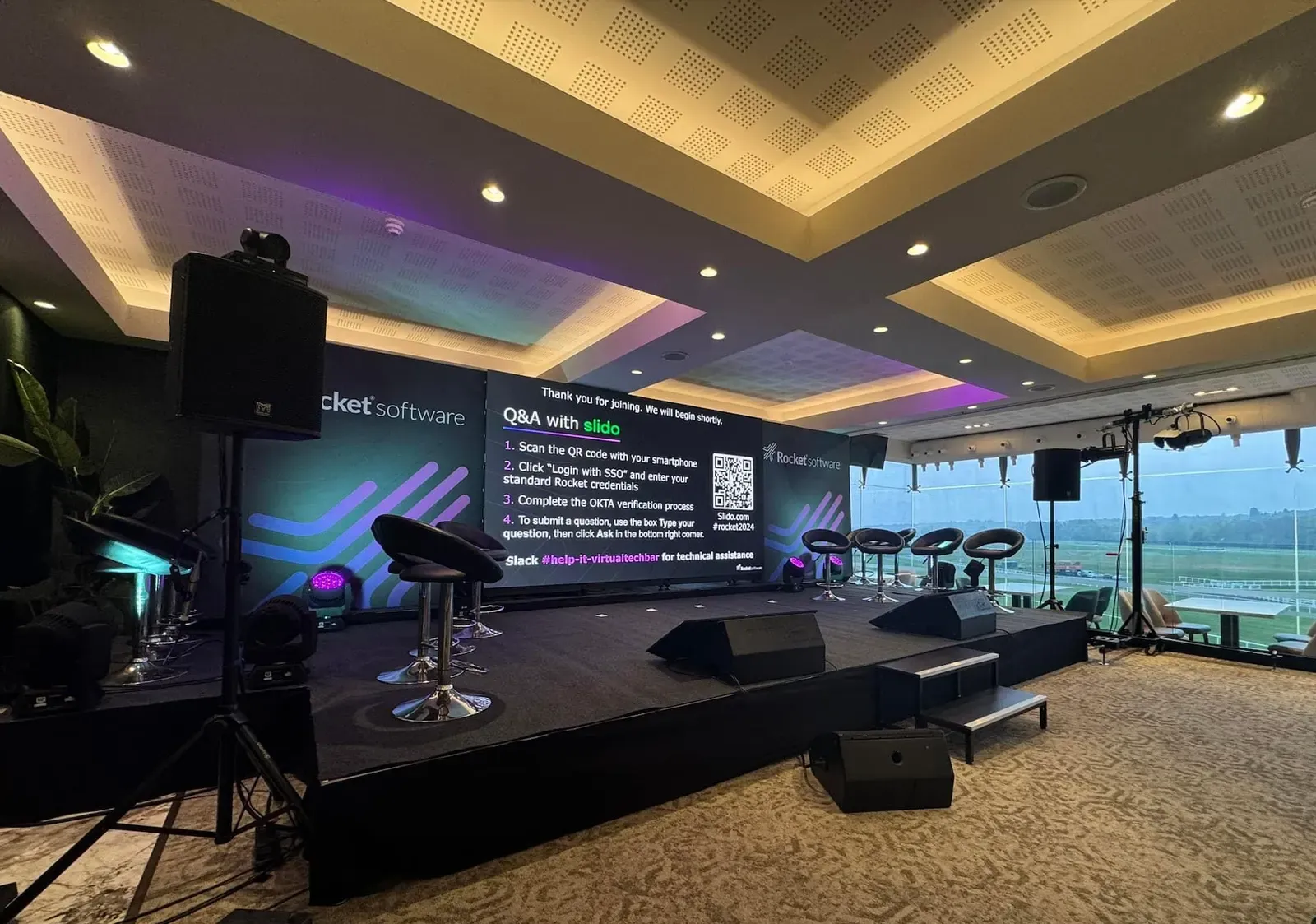
A product launch is a show with a single job: land the reveal. Everything before the reveal exists to set it up, everything after exists to reinforce it, and the AV plan is the scaffolding that makes the moment work. Marketing directors rarely run AV day-to-day, but the choices made early — room shape, stage format, content workflow — shape what is possible on the day. This checklist is organised in the order decisions actually get made, not the order equipment arrives on site. It assumes a mid-market London launch of 150-400 guests with a keynote and a reveal.
1. Define the moment before you design the stage
The first question is not what the stage looks like — it is what the audience sees, hears and feels at the moment of reveal. Write that moment in one sentence: the video wall shifts from the brand campaign to a live product shot, a presenter steps into a pool of light, the room's sound drops from ambient to a single brand note. The sentence is the creative brief for every AV line that follows.
- Write the reveal moment as one sentence — one sight, one sound, one action
- Decide if the product is physical on stage, shown on screen, or both
- Agree whether there is a countdown, a silence, or a build into the reveal
- Identify who makes the call live — a show-caller, not the CMO
2. Room, stage and sightlines
The venue's floor plan is either your friend or your first problem. A wide, shallow room gives more front-row seats but forces a wider stage and more lighting cover. A narrow, deep room gives better IMAG economics — you can put camera repeats on side screens — but pushes the back row further from the action. A room with columns needs an early decision about where the cameras sit, because columns will block some seats no matter what.
The minimum viable stage for a product launch is deeper than most marketing directors expect. Allow at least 3 metres of depth behind the presenter for a set, LED wall or scenic — less than that and the stage reads flat on camera. Height matters too: the presenter's eyeline should sit roughly mid-way up the LED wall, not below it.
3. Sound: intelligibility, then impact
The job of the PA at a product launch is, in order: speech intelligibility, music fidelity, and impact during the reveal. Too many launches buy a system for impact and discover on the day that the keynote is not landing at the back of the room. A d&b audiotechnik line array with a system tech tuning it in the morning is the quiet benchmark; anything less at 150+ guests tends to trade speech clarity for cost.
Microphones are the other half of the job. Two lavaliers per presenter (a primary and a redundant), one handheld on a stand for Q&A, and a named A2 whose only job is to swap packs and manage batteries. The single most common reason a launch goes sideways is a dropped mic — and it is preventable.
Budget rule: if the choice is between a bigger LED wall and a proper PA with a system tech, pick the PA. A launch that sounds thin reads cheap, no matter how the screen looks.
4. Video, LED and content workflow
LED resolution is set by viewing distance, not by how much the panel costs. For a room where the front row is 4 metres from the wall, a 2.6mm pitch is appropriate. For a room where the front row is 8 metres back, 3.9mm is fine. Going finer than the room needs is spending budget that the audience will not see. Going coarser is visible from the first row and will be noticed on camera.
Content workflow is where launches quietly fall apart. The content team (usually the marketing team or their agency) and the AV team need one named person who owns the hand-off. Final versions arrive a clear 48 hours before the event, in the codec and aspect ratio the screen actually is, with a tech check on the real system the day before. Anything less and you are editing content during rehearsal, which eats the time you needed for the show itself.
- LED pitch matched to the viewing distance, not the budget maximum
- Content delivered 48h out, in the correct codec and aspect ratio
- One named person owning the content-to-AV hand-off
- A tech check on the final rig the day before, not on show day
- Countdown, holding slides and emergency slides built and tested
5. Lighting: support the face, frame the reveal
Stage lighting at a launch has two jobs: keep the presenter's face correctly exposed for the cameras and the room, and shift the mood around the reveal. The first is technical — a front key, a back light, a fill — and is handled by your lighting operator. The second is creative and needs a short conversation between the show-caller, the LD and the content team about what cue fires on what count.
Robe and Ayrton moving fixtures are the working currency of a premium launch rig. The question is not which fixture but how many cues and who calls them. A lighting designer who has seen the content and rehearsed with the show-caller will deliver a cleaner reveal than one who is reading the script for the first time at the tech check.
6. Rehearsal, run sheet and risk
The single biggest predictor of a clean launch is rehearsal time. Two full run-throughs on the real rig, with the real content, with the real presenters, will surface problems that no tech check finds. The budget cost of the rehearsal is crew hours and venue access — modest against the cost of a reveal that stutters.
The run sheet is the second half of rehearsal's value. A minute-by-minute document, owned by the show-caller, that every supplier has seen. It lists cues, lighting states, content triggers, mic swaps, and the named person responsible for each. When something moves on the day — and something always does — the run sheet is what keeps the rest of the show on track.
7. The ten-minute pre-flight
Ten minutes before doors, the show-caller runs a short pre-flight with every department. PA confirmed on, gain structure checked, standby mics tested. Lighting confirmed in pre-set state. LED confirmed in holding loop. Cameras and comms confirmed. Presenters in position. Content team confirmed on standby. The pre-flight takes ten minutes and catches roughly 90% of the problems that would otherwise surface during the show.
We have built this pre-flight into corporate launches and brand activations from the Aston Martin Owners Club meet at Royal Berkshire Polo Club to GoDaddy Women in Technology. The content, venue and scale change every time. The checklist does not.
8. The post-event assets marketing directors forget to brief
A product launch is a one-night event and a twelve-month content asset. The AV plan should reflect both. That means camera coverage designed not just for IMAG on the night but for post-event edits — clean angles on the presenter, cutaways of the audience, B-roll of the product reveal from two camera positions. Brief the camera team on the edit, not just on the live show, and the post-event film writes itself.
Audio is the other often-forgotten asset. A clean board mix from the PA, recorded at the desk, is a 30-second budget line that saves a lot of audio cleanup in post-production. The same applies to press photography — one named photographer with a brief that lists the shots marketing needs, not a generalist working on instinct.
- Clean camera angles designed for post-event edit, not just IMAG
- Board mix audio recorded at the desk, not relying on camera audio
- Photographer briefed with a specific shot list from the marketing team
- Content rights clarified in advance — who owns the edit, and for how long